



If your brand names can’t survive typos, abbreviations, and casing changes, your analytics can’t either!
Picture this. You search your database for a single company and get twelve different variations back. You stare at the screen wondering if your data engineers took a vacation.
Welcome to the messy world of brand data. We at Deswave see this chaos every single day. Companies bleed money because they refuse to clean their text inputs. A Complete Guide for Brand Name Normalization Rules is your way out of this mess.
If you want to survive the generative search era in 2026, you need clean data. Period.!
The generative search engines and LLMs punish bad data catalogs brutally. You lose rankings rapidly. Your category page SEO drops because search indexes become incredibly bloated.
We remember when a client lost fifty thousand dollars in sales just because their system created three duplicate pages for a single shoe brand. They ignored the rules completely.
Don’t make their exact mistake. We’ll show you how to force your text into a standardized format.
You’ll learn the exact steps to build a bulletproof normalization pipeline from scratch with our brand name normalization rules. This blog gives you everything you need. Get ready to fix your broken data systems once and for all.
Tame Your Wild Data
Don’t let duplicate records and bad spellings drain your marketing budget. Deswave turns messy text into clean, high-ranking catalogs overnight.
Get Your Free AnalysisWhy Brand Name Normalization Matters for Data Quality?
It’s a fact that bad data destroys your bottom line. You might think a few misspelled words don’t matter much. You’re absolutely wrong (sorry, not sorry). Search engines are dependent on exact matches to understand your catalog. When you have five to eight versions of one company name, your systems panic in chaos.
They fail to group products together accurately. Your customers search for a specific item and find absolutely nothing. They leave your site and buy from your biggest competitor. We learned this the hard way at Deswave during a massive catalog migration.
In the beginning, we genuinely had complete faith in the raw input files. That was a huge error. Because the deduplication algorithm was unable to identify that two names were identical, it crashed.
Your e-commerce SEO and GEO algorithms will function properly if the language is clear and easy to read.
Your machine learning models need predictable inputs to train adequately. If you feed them garbage, they will just predict more garbage. Brand name normalization forces consistency across every single row in your database.
You produce a real single source of truth. Your analytics finally make perfect sense. Your reporting stops lying and deceiving you. Clean data is NOT just a nice bonus. It’s a mandatory and inevitable requirement for survival.
Core Normalization Rules for Brand Names Standardization at Scale
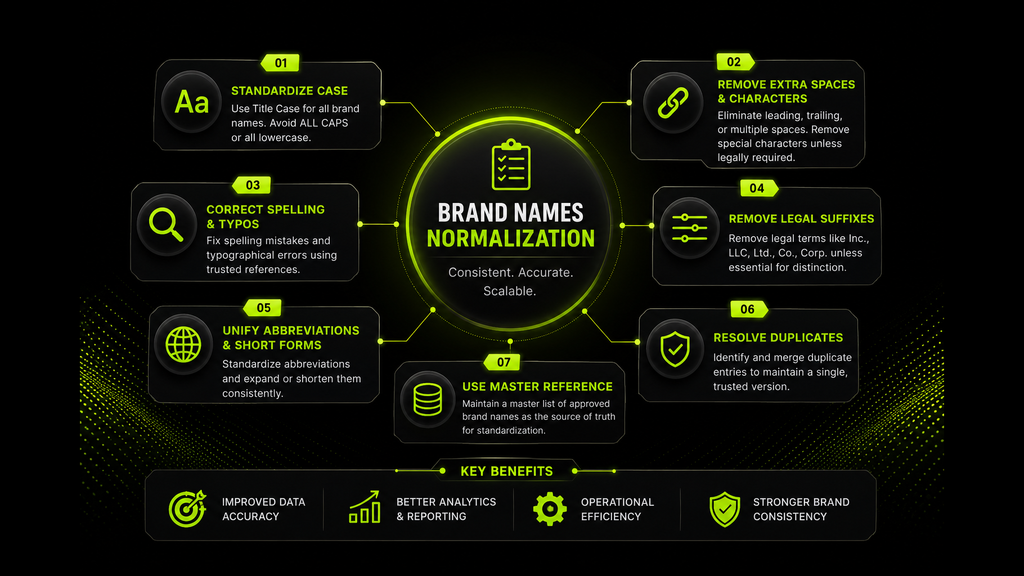
Scaling your text processing requires strict rules. You can’t rely on human reviews when you process millions of rows daily. You need a fast automated pipeline. First, you must establish an absolute master registry.
Every new entry MUST compare itself to this registry. If it fails the check, the system rejects it immediately.
Next, you enforce strict character limits and encoding standards. UTF eight is your best friend here. Drop any weird encoding formats before they poison your database.
We once spent three full days debugging a pipeline only to find hidden characters ruining the match logic. Never again. Deswave engineers now run aggressive encoding checks on step one. You also need rule based changes that run in a specific order. You strip the legal suffixes first.
Then you fix the spacing. Finally, you standardize the capitalization. Changing this exact order breaks the whole process. You must process the text the same way every single time.
Predictability scales incredibly well. Chaos doesn’t scale at all. Build your pipeline to handle the worst possible inputs, and you’ll never worry about bad matches.
Handling Spelling Variants, Misspellings, and Common OCR Errors
Optical character recognition is a constant source of fear for data technologists. Letters are often misunderstood by OCR software. They substitute a zero (0) for the letter O. They substitute a L for an I. Your matching logic is broken by odd spelling variances.
You can’t prevent these errors at the source. You have to catch them in your pipeline. We use algorithmic distance checks to find these mistakes. We measure how many letters changed between the input and the master name.
If the distance is tiny, we auto correct it. You also see humans typing fast and making typos. They drop vowels. They double consonants. You need a dictionary of common misspellings linked to your master registry.
When Deswave built a custom ecommerce index last year, we found thousands of products lost because of single letter typos. We wrote a script to catch and replace them instantly. The sales jumped overnight.
You must assume every input contains a typo. Build aggressive fuzzy matching rules to catch the obvious mistakes. Send the really weird ones to a manual review queue. Trust no raw input.
Removing Noise Words like Official and Group Without Losing Meaning
Many companies add useless filler words to their profiles. They call themselves the official group or the global network. These words destroy your search rankings. They dilute the actual brand identity. Your deduplication script reads these extra words and thinks it found a totally new company.
Nothing new was discovered. More noise was just imported by you. You have to aggressively remove these empty terms. Make a list of terms such as international, global, official, and group. Your pipeline eliminates them entirely when it detects them.
We faced this exact problem at Deswave with a massive global supplier catalog. The supplier added the word global to every single product line. Our index grew by forty percent with pure garbage data. We wrote a regex script to rip those specific words out. The index size dropped dramatically.
The search speed doubled. You have to be careful, though. Sometimes the word is part of the actual identity. You don’t delete the word group from a financial bank that actually uses it as their core name.
Use targeted exception lists to protect real names while nuking the noise.
Case Folding and Whitespace Normalization Best Practices
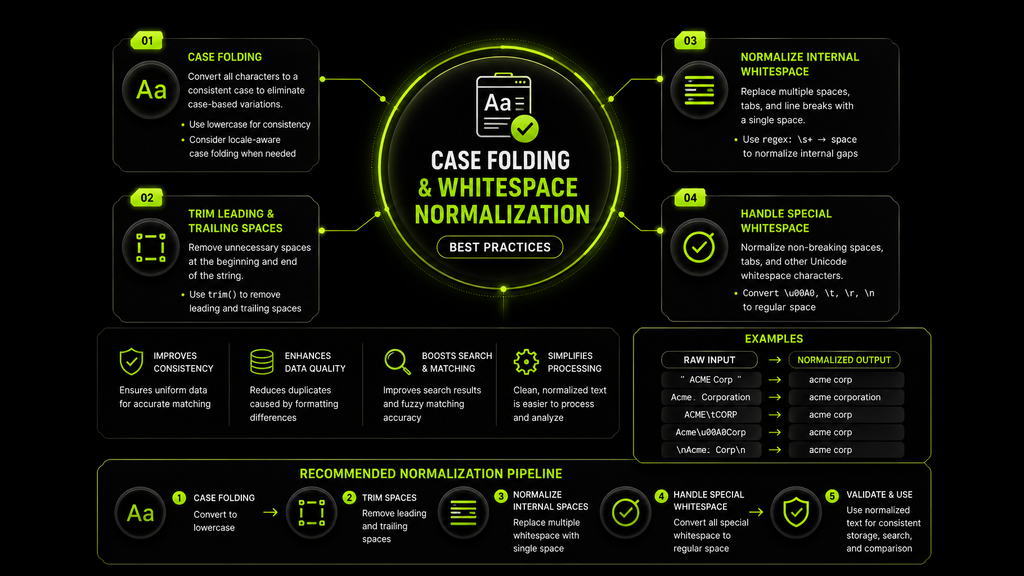
Capitalization and spaces will ruin your matching rules. Computers see a capital letter and a lowercase letter as completely different things. They see two spaces the exact same way they see a brick wall. They literally stop matching.
You must force all text into a single case format. Lowercase is the absolute standard. You convert every single letter to lowercase before you do anything else.
This simple process is called case folding. It immediately solves half of your duplicate issues. Spaces are the very next enemy.
Users add spaces by accident all the time. They put them at the end of words. They put double spaces between words. You must trim the edges. You then collapse any internal double spaces into a single clean space.
We once watched a massive data migration fail because one engineer forgot to trim trailing spaces on a CSV import file.
Deswave spent an entire weekend fixing that specific disaster. We now run aggressive whitespace trimming on every single text string. Don’t trust user inputs blindly. Squash all the spaces. Fold all the cases.
Tokenization Rules for Multi Word Brand Names and Abbreviations
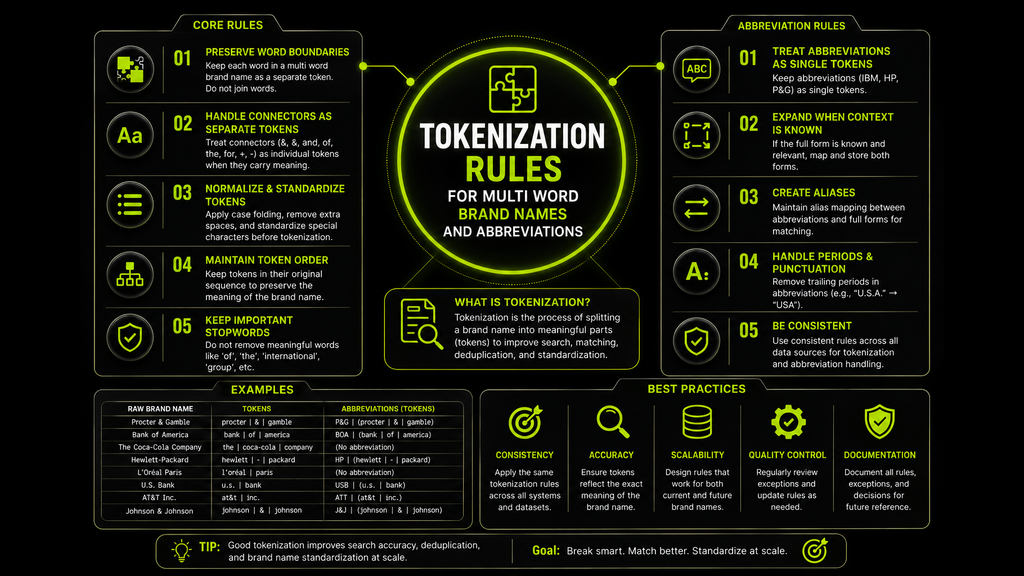
Long names break simple rules easily. You can’t just match a whole string when the company has four different words in its title. You need to break the string apart into much smaller pieces.
We call this tokenization. You split the text by spaces. You then evaluate each piece individually. This lets you catch abbreviations easily. People hate typing long names. They shorten them to initials. If your system can’t connect the initials to the full words, you lose data. Build an alias dictionary. Map the common abbreviations directly to the full tokens.
When a user types the short version, your system replaces it with the full tokenized version automatically. Our team at Deswave built a token engine for a retail client last spring. Their clients kept using random acronyms for sports brands. We mapped every known abbreviation to the master tokens.
Managing Punctuation and Special Characters Across Systems
Punctuation is a total nightmare for data engineers. Commas and periods add zero value to your match logic. They only cause irritating errors. A name with a comma will never match a name without one.
You must destroy the punctuation. Build a regex script to find every single period and comma. Delete them instantly. Ampersands are another massive headache. Some users type the word and.
Others type the ampersand symbol. Your database gets confused and creates annoying duplicate records.
Pick one standard and stick to it. Convert every ampersand into the word and. Do this before you run any matching scripts. Apostrophes require a different approach. You usually want to keep them because they define the actual spelling for many prominent companies.
We remember a specific project at Deswave where an eager junior developer deleted all apostrophes. Half the restaurant catalog broke because the names merged into complete gibberish.
We had to roll back the entire massive database. Treat special characters like a direct threat. Isolate them quickly. Standardize the ones you need. Delete the rest without any mercy or hesitation.
Normalizing Legal Entity Suffixes Ltd Inc SA and Company
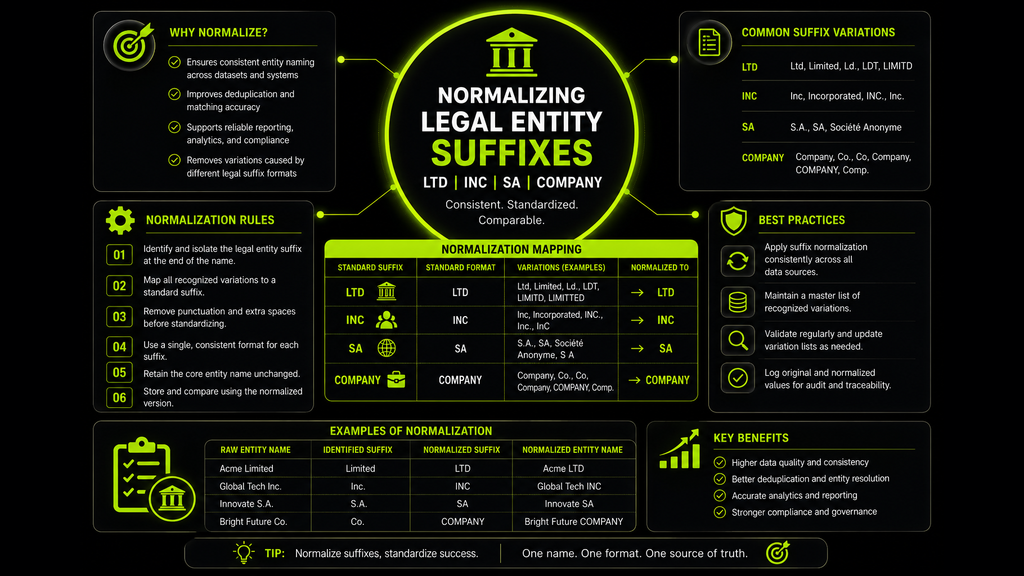
Legal suffixes belong on corporate tax forms. They don’t belong in your search index. Words like incorporated or limited add massive noise to your text. A user will never search for a shoe by typing the word incorporated.
They just want the shoe. When you leave these suffixes in your data, you create endless duplicates. Your system sees one record with the suffix and one without it. It assumes they are two totally different entities.
You must strip these legal terms out completely. Build a comprehensive list of every legal suffix in your target regions. Include the abbreviations and the full spellings. Force your pipeline to scan the end of the text string.
If it finds a direct match, it deletes the suffix. We do this for every single client at Deswave. We cleaned up a massive vendor list last month.
The client had hundreds of duplicate suppliers just because of the word LLC. We ran our suffix stripper and wiped out the duplicates in ten seconds flat. Clean your endings. Drop the useless legal garbage. Keep the real brand name.
Building and Validating a Brand Normalization Ruleset
Don’t guess your way through difficult data cleaning. Your brand identity deserves better than random guesswork. You need a strict playbook. This living document becomes the absolute law for your entire engineering team.
Every step needs a clear purpose and an exact sequence. You write these brand name normalization rules down. Then you make everyone follow them perfectly.
But writing rules is only the first step. You have to test them against real data constantly. We once saw a huge retailer corrupt half their product catalog because they skipped basic testing.
A single bad rule ruins millions of records in minutes. Testing is completely mandatory. You’ve got to prove the pipeline works before you push it live.
Here is how we protect your brand data at Deswave:
- Build a secure sandbox environment where you can test safely
- Throw the messiest raw data you can find at your new ruleset
- Break the rules in the sandbox so they survive in the real world
- Check the final output manually to ensure total accuracy
Measure the before and after states carefully. If the data looks cleaner, you approve the release. Never deploy untested rules to your live system. Watch your search rankings and your brand strategy.
Ready to Fix Your Messy Data?
Stop losing revenue to bad search indexes and broken product catalogs. Let our expert data engineers build a custom normalization pipeline for your business today.
Book a ConsultationFrom Rules to Matching: How Normalization Improves Deduplication and Search
Rules mean absolutely nothing if they fail to fix your search engine. The entire goal here is making your matching logic flawless. You want your deduplication scripts to actually work. Human psychology plays a huge part in this process.
Customers get frustrated and leave when they search for a brand and find a broken catalog. Clean data removes that friction instantly.
Once you apply strict brand name normalization rules, your exact matches skyrocket. The duplicate records vanish completely. Your database finally shrinks down to a healthy size. This directly boosts your ecommerce revenue.
In order to rank your pages, 2026 generative search engines will require the best catalogs. AI models will penalize your website if you provide them an unsettling database. They will reward you with enormous prominence if you provide them clean text.
We saw this firsthand at Deswave recently. We built a custom pipeline for a huge retail client who was bleeding sales to duplicate pages.
They finally stopped fighting their own messy data. The search engine crawlers absolutely loved the new clean index. Their organic traffic doubled overnight.
Here is how you clean data drives your CRO strategies:
- Search algorithms finally understand your total inventory without guessing
- Customers find the exact brand they want without scrolling through duplicates
- AI models parse your catalog perfectly for GEO rankings
- Your team stops wasting precious hours fixing broken product listings manually
Normalization is your secret weapon this year. Clean your text today.
Let the search algorithms do their actual job and watch your search performance explode. The final results will completely shock you.
Ready to Fix Your Messy Data
Stop losing revenue to bad search indexes and broken product catalogs. Let our expert data engineers build a custom normalization pipeline for your business today.
Book a ConsultationRecap
Stop letting messy data destroy your sales. Brand name normalization rules fix broken catalogs and force search engines to rank your pages higher.
We created Deswave to kill these exact data nightmares. Clean your text today and watch your online revenue explode completely.
Brand name normalization rules turn messy data into a single clean format. You set strict guidelines to strip out legal suffixes and fix spacing errors.
This forces every single company record to match perfectly.
Messy text destroys your search catalogs and creates confusing duplicate pages. Clean data ensures your search engines actually work.
You stop losing customers to broken product links and finally see your true sales numbers.
We always build a master registry as our single source of truth. You write specific scripts to remove extra spaces and drop useless corporate suffixes.
Always test your new logic in a safe sandbox.
We once watched typos crash an entire database. People make careless errors when they type fast. Software systems misread scanned documents.
Companies rebrand without telling anyone. These tiny mistakes create massive business problems.
Yes. When you follow strict brand name normalization rules, your customers always find the exact products they want.
Smart search engines reward clean catalogs with higher rankings. Better visibility directly grows your market presence.
We often see five different spellings for one single company. Users might type Wal Mart instead of the official name.
Some people add LLC to the end while others drop it completely from records.
Stop letting people type whatever they want. Use drop down menus and auto complete fields to control the input.
Run every new entry through your cleaning pipeline before it reaches your live database.
I hate doing this boring work manually. You need intelligent machine learning scripts that catch spelling mistakes automatically.
Good tools use fuzzy matching to spot typos and connect abbreviations to their master names.