




Building a business without a brand strategy feels like setting sail with a hole in your hull and expecting to win a yacht race.
Most founders dump cash into hollow social media ads, hoping for a miracle, while competitors steal their market share by simply knowing who they are.
Brand strategy services provide the compass your company lacks. They turn vague mission statements into hard profit drivers.
If you treat branding as a creative hobby instead of a technical asset, prepare to get crushed by rivals who actually track their metrics.
Deswave built this guide to help you stop guessing and start dominating.
We cover how to position your offer, convert cold leads, and lock in long-term growth.
Stop bleeding budget on experiments. Read on to build a brand engine that actually scales revenue.
How to Own a Clear Market Space with Brand Positioning Strategy?
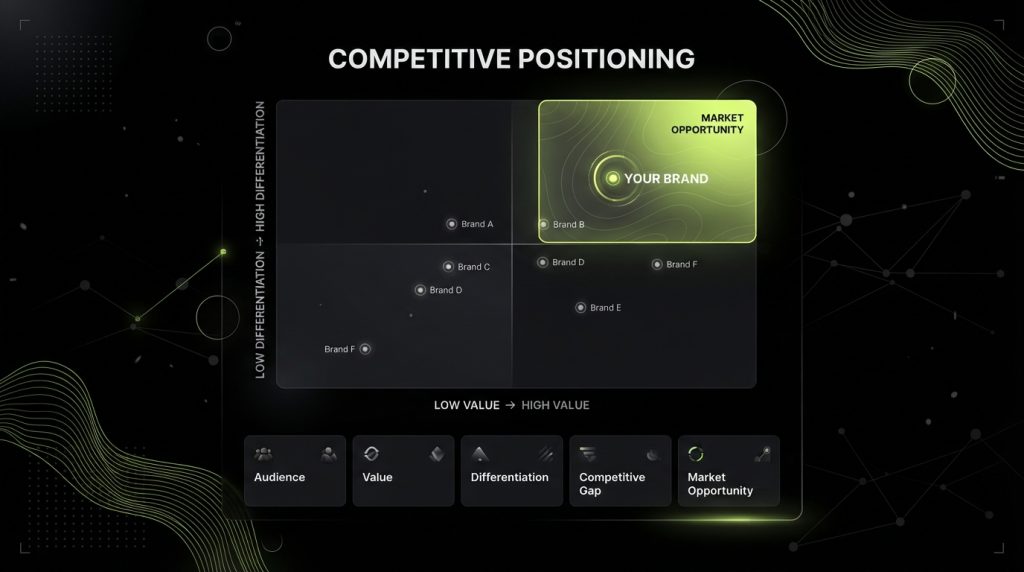
Positioning defines exactly where you sit in the mind of your prospect relative to every other option. You either occupy a distinct category or you compete solely on price.
Price wars kill margins. To win, you must identify a specific market white space where your solution solves a problem nobody else touches. Analyse competitor feature sets and pricing tiers to find gaps.
Map these findings against your unique core competencies. Craft a positioning statement that highlights one singular benefit your audience craves but currently lacks.
This focus forces clarity across every department. When you claim a specific corner of the market, you stop being a commodity.
You become the default choice for a defined group of buyers. Own your niche territory before someone else plants their flag there first.
Audience Research and Segmentation Tactics for Building Buyer Profiles That Convert
General marketing appeals to everyone and convinces nobody. High performance requires deep audience research that moves beyond basic demographics.
Study your existing customer database to identify common behavioural patterns and pain points.
Create buyer personas based on real interview data rather than imaginary profiles. Group these segments by their buying triggers and the specific friction they face during the decision process.
Map out their job titles, daily frustrations, and the underlying goals driving their purchase intent. Use social listening tools and survey feedback to confirm these assumptions.
When you understand the psychological levers behind a sale, you write copy that speaks directly to their needs.
You stop shouting into the void and start building direct connections with the people most likely to pay you today.
Precision targeting lowers your acquisition costs immediately.
Messaging and Value Proposition Writing That Explains Why You Win
Your value proposition tells the prospect why they should care about you within five seconds of landing on your site. Most companies hide their value behind corporate jargon that confuses visitors.
Strip away the fluff. State exactly what you do, who you help, and the tangible outcome you deliver. Use customer language instead of internal marketing speak.
Frame your messaging around their specific transformation rather than your internal feature list. Identify your primary competitive advantage and turn it into a hook.
Does your service save them ten hours a week? Does it reduce their operational risk by half? Lead with that quantifiable result.
Clear messaging acts as a filter that attracts qualified buyers while repelling those who do not fit.
Write for the customer who desperately needs your specific solution right now.
Visual Identity Alignment: Ensuring Design Supports Strategy Across Channels

Design serves as the physical proof of your brand promise. Inconsistent visuals signal amateurism and destroy buyer trust.
Your visual identity system must reflect your positioning statement accurately across every touchpoint.
If your brand promises high-end luxury, but your website uses low-resolution stock photos and broken layouts, you lose credibility instantly.
Develop a strict brand style guide covering colour palettes, typography, icon styles, and image treatment.
These assets ensure your brand remains recognisable whether a lead sees an email, a landing page, or a printed brochure.
Align your design language with the emotional response you want to trigger in your audience.
Consistent visual systems reduce cognitive load for users and create a sense of professional permanence.
Design exists to support your business goals, not to look pretty for the sake of trends.
Linking Brand Strategy and Go-to-Market Planning to Launch Execution
Strategy without a launch plan remains a document gathering dust. Go-to-market planning bridges the gap between your brand identity and real-world sales revenue.
Coordinate your internal teams so that product, marketing, and sales share the same narrative during a launch.
Align your messaging across landing pages, email sequences, and paid search campaigns before the public reveal.
Set specific launch milestones and KPIs to measure immediate market reaction.
Use phased rollouts to test your messaging resonance with small audiences before scaling spend. This controlled approach prevents wasted budget on unproven hooks.
When every channel speaks the same language at the same time, you create momentum that forces the market to pay attention.
Execution brings your strategy to life.
Without this synchronised effort, your brand remains an invisible concept rather than a market force.
Turning Brand Touchpoints into Measurable Outcomes with Customer Journey Mapping
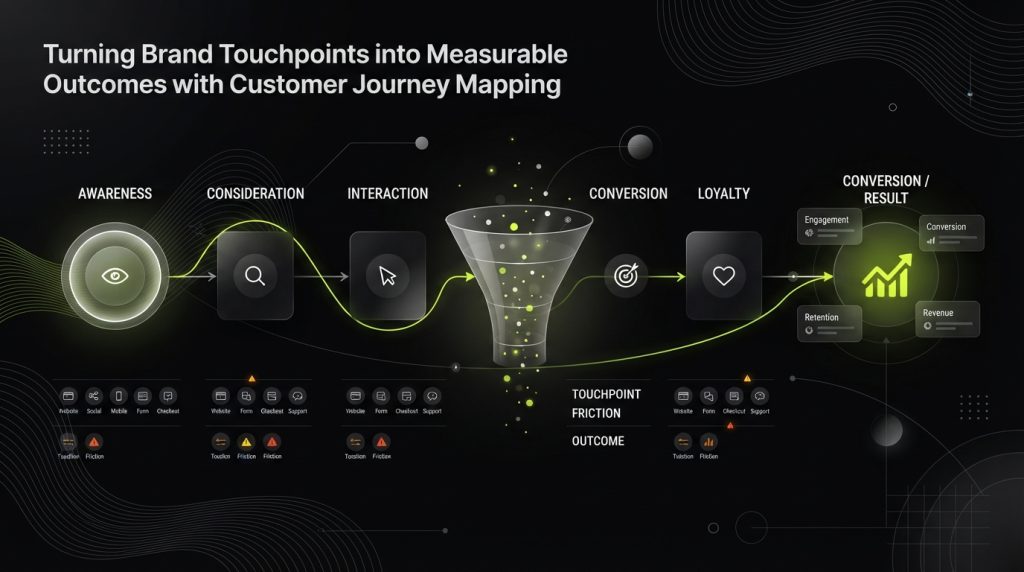
Every interaction a prospect has with your company either builds equity or erodes it. Customer journey mapping visualises this path from the first touchpoint to the final conversion.
Audit your website, social profiles, email flows, and sales calls to find hidden friction.
Where do leads drop off? Which pages fail to answer critical buyer questions? Plug these leaks by optimising content for each stage of the funnel.
Provide the specific information they need exactly when they look for it.
This creates a friction-free experience that encourages action.
Track user behaviour data to validate your assumptions and refine the journey continuously.
Treating the journey as a technical pipeline allows you to predict conversions and scale your revenue predictably.
A mapped journey turns passive visitors into active, long-term customers by removing every excuse to leave.
Keeping Consistency Across Teams and Partners with Brand Governance and Guidelines
Brand decay happens when internal teams and outside contractors interpret your identity differently. You need formal brand governance to prevent this dilution.
Create a central brand portal where all stakeholders access approved logos, fonts, templates, and messaging guidelines.
This resource removes the guesswork for employees and vendors alike. Require all external communications to pass through a quality control review process.
When everyone follows the same rules, your brand remains sharp and recognisable at every touchpoint. Treat your brand guidelines as a living document that evolves as your business grows.
This strict adherence creates institutional authority that competitors cannot replicate. Consistency builds trust, and trust drives higher lifetime customer value.
Do not let fragmented design or off-brand messaging sabotage your hard-earned market reputation. Enforce these standards relentlessly across every single business department.
Brand ROI Measurement: Tracking Costs, Revenue Signals, and Long-Term Lift
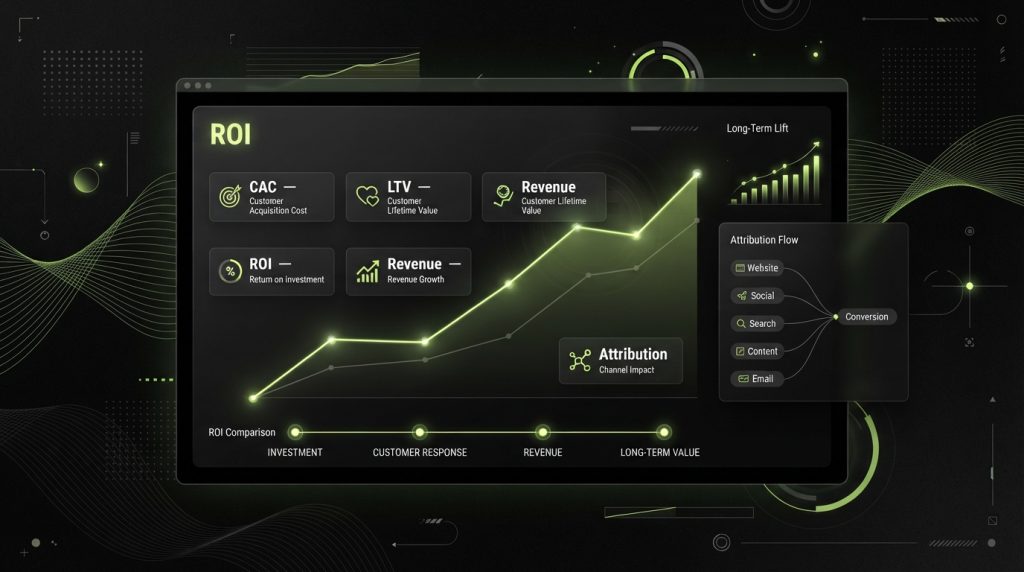
You cannot manage what you do not measure. Track the financial health of your brand by monitoring specific metrics that correlate with revenue. Watch direct traffic growth, branded search volume, and customer acquisition costs over time.
High brand equity lowers your dependency on paid ads because people search for you by name.
Calculate the lifetime value of your customers and compare it against the cost of your branding initiatives.
Use attribution modelling to see how your content and messaging influence the final sale.
If your brand strategy shows no movement in these core signals, adjust your positioning or messaging immediately. Brand building requires an investment mindset.
Treat these costs as capital expenditures that yield compounding returns through market authority, pricing power, and reduced churn.
Profit is the ultimate metric for any strategy.
Brand strategy services provide a technical roadmap for defining your company’s identity, market position, and messaging.
Experts analyse your audience and competitors to build a cohesive framework that drives long-term recognition and customer loyalty.
These services align your marketing with actual buyer needs, reducing acquisition costs.
By sharpening your value proposition and targeting the right segments, you convert leads faster and command higher prices through stronger market authority.
Without a clear strategy, your brand remains invisible and generic.
A defined identity guides every decision, ensures consistent communication, builds trust with your audience, and prevents wasted budget on unfocused, ineffective marketing campaigns.
Comprehensive services include audience research, competitor analysis, positioning statements, and messaging frameworks.
Providers also deliver visual identity guidelines, customer journey mapping, content roadmaps, and governance structures to ensure total consistency across every marketing channel.
They replace guesswork with data-backed decisions. By crafting a unique narrative and visual system, you create professional, memorable experiences at every touchpoint.
This consistency builds deep emotional connections that keep customers returning to you.
Yes. Strategy identifies specific market white spaces where competitors fail to deliver.
By highlighting your unique advantages and solving specific customer pain points, you move from being a commodity to the preferred industry expert.
Invest early when launching a new company or whenever your current growth stalls.
Seek professional help before major rebrands, during market expansions, or when your current messaging fails to attract high-quality, profitable leads consistently.
Most projects take four to eight weeks, depending on complexity.
This timeline allows for thorough discovery, stakeholder interviews, creative development, and final refinement, ensuring the resulting strategy serves as a scalable, long-term business asset.
Conclusion
A solid strategy transforms a generic business into an industry leader. Deswave crafts technical brand frameworks that clarify your value proposition, eliminate wasted marketing spend, and turn passive prospects into loyal customers.
Claim your market space, outshine competitors, and scale revenue consistently by aligning your messaging, design, and brand strategy services built to grow.
Ready to Build a Brand That Actually Drives Growth?
Stop guessing and start scaling. Our brand strategy services turn vague positioning into a clear, measurable growth engine from market positioning and messaging to visual identity and ROI tracking.