




So, how much does it cost to build a website in 2026? For most small businesses, a professionally built site costs $3,000 to $15,000. DIY builders start near $17 a month. Enterprise platforms can pass $100,000. Your website development cost depends on size, features, design, and who does the work.
Here’s the catch. One big number on a quote tells you nothing. A good web development company splits that number into design, code, content, testing, and support. This guide shows you how to read those line items, catch hidden fees early, and build a budget you can defend.
You might be a Gen Z founder with a side hustle or a Millennial owner replacing a 2014 site. Either way, you’ll leave knowing what to ask and what to refuse.
Key Takeaways
- Website development costs in 2026 range from about $500 for a DIY site to $100,000 or more for an enterprise build.
- Most small-business websites cost between $3,000 and $15,000.
- Remember to budget annually for hosting, security, and maintenance.
- Compare freelancers, agencies, and website builders before choosing a solution.
How Much Does Website Development Cost in 2026?
Website development cost in 2026 swings from a few hundred dollars to six figures. Short answer first. Small business sites usually cost $3,000 to $15,000 according to Digital Applied’s pricing data, and NEWMEDIA reports a similar $2,000 to $15,000 band. DIY builders cost far less. Custom stores and enterprise platforms cost far more.
Why so wide? One website development price can hide four different charges. An hourly rate pays for a developer’s time, such as $85 to $135 for a mid level US freelancer. A one time fee covers the build. Monthly subscriptions cover tools like Wix, Shopify, and hosting. Annual costs cover domains, SSL, and maintenance. Mix them up and a quote looks cheaper than it is.
Here’s the warning. Every number in this guide is a planning range, not a quote. The ranges come from public 2026 pricing guides that use different assumptions. Before you commit, demand a scoped estimate that lists what’s included and what isn’t. If a vendor refuses to itemize, walk away.
Average Website Development Cost by Website Type

The cost of website development starts with one question. What are you building? A five page brochure site and a custom web app share a name and almost nothing else. The table shows typical 2026 ranges pulled from published pricing guides. Assumptions include US pricing, a professional build for anything above DIY, and no ongoing costs.
|
Website type |
Typical 2026 build range |
Typical timeline |
Core technology |
Best for |
|
Personal |
$0 to $1,800 |
1 to 4 weeks |
Builder or WordPress theme |
Portfolios, blogs, resumes |
|
Small business |
$3,000 to $15,000 |
4 to 8 weeks |
WordPress, Webflow, or light custom code |
Local services, consultants |
|
Corporate |
$20,000 to $40,000 |
Scoped per project |
CMS with custom templates and APIs |
Mid sized firms with several teams |
|
Ecommerce |
$3,000 to $6,000 hosted, $45,000 to $250,000 custom |
8 to 16 weeks and up |
Shopify, WooCommerce, or custom Node.js |
Online stores |
|
Custom |
$10,000 to $25,000 basic, more with features |
8 to 16 weeks and up |
React, Next.js, Vue, custom back end |
Unique workflows |
|
Enterprise |
$75,000 to $500,000 or more |
Scoped per project |
Cloud stack, custom CMS, single sign on |
Large and multi market brands |
|
Web application |
Scoped quote, enterprise apps reach $500,000 or more |
Scoped per project |
Node.js or Python back end, React front end, database |
SaaS, portals, dashboards |
Sources behind these ranges include Ueni, NEWMEDIA, Digital Applied, SimPalm, and Tekrevol. Each source uses its own assumptions, so treat the table as a starting point for questions, not a promise.
Personal Website
A personal website, like a portfolio, resume, or blog, costs the least. Wix lists paid plans from $17 to $159 a month on annual billing, and WebsiteSetup puts a DIY WordPress start at $95 to $180 for year one.
Most personal sites need five pages or fewer, one contact form, and basic SEO. You trade cash for your own time. Watch one trap. Free plans often show ads and block custom domains, which looks sloppy if you’re job hunting or selling services.
Spend the few extra dollars on a real domain and clean email.
Small Business Website
Most readers land here. A small business site usually has five to fifteen pages, service pages, a contact form, a blog, and local SEO basics.
Digital Applied puts the build at $3,000 to $15,000. Why the gap? A $3,000 site often runs on a template with light edits. A $15,000 site adds custom design, professional copy, structured data, and speed tuning. Always ask what a quote includes.
A website creation cost that leaves out copy and photos isn’t a real price, because you’ll pay for those anyway.
Corporate Website
Corporate websites serve more people, so they cost more. SimPalm estimates $20,000 to $40,000 for mid sized businesses. You’re paying for multiple user roles in the CMS, approval workflows, press or investor sections, and brand rules across dozens of templates.
Add single sign on or CRM connections and the build grows again. Corporate sites also face stricter reviews for accessibility and privacy. Budget for a content audit before the build. Cleaning and moving hundreds of old pages takes real developer hours, and agencies bill for every one of them.
Ecommerce Website
Online stores carry two price tags. A hosted store like Shopify starts at $29 a month on annual billing, plus a setup fee. Ueni lists $3,000 to $6,000 for ecommerce builds. A custom store plays a different game, and Digital Applied lists custom ecommerce at $45,000 to $250,000.
That jump pays for custom checkout flows, inventory syncing, and complex shipping rules.
Payment processors also take a cut of every sale, often near 2.9% plus 30 cents per card payment. So the cost to build a website for a store never stops at launch day.
Custom Website
A custom website means a developer writes code for your exact needs instead of editing a template. One 2026 small business guide puts basic custom builds at $10,000 to $25,000.
Custom work suits companies with unusual workflows, like quote calculators, booking engines, or member portals. You get full control over speed and security.
You also own the upkeep. WebsiteSetup says a custom CMS alone can cost $20,000 to $75,000. So ask a simple question first. Would a template plus a few custom features solve the problem for less money?
Enterprise Website
Enterprise sites serve huge audiences under strict internal rules. Digitano pegs large organization builds at $75,000 to $500,000 or more. That bill covers cloud architecture, load balancing, single sign on, multi language content, audit logs, and security reviews.
Many teams touch the project too, including legal, IT, marketing, and product.
Meetings cost money. Expect a long discovery phase before anyone writes code. It feels slow, but it prevents expensive rework later. If you need uptime promises, add the cost of a service level agreement and round the clock monitoring.
Web Application
A web application does work for users instead of just showing pages. Think customer portals, booking tools, dashboards, and SaaS products. These need user accounts, databases, permissions, and APIs, so the website development cost runs higher than a content site of the same size.
Tekrevol places enterprise web apps above $500,000 at the top end. Smaller apps cost far less, but no honest developer can name a price without a scope.
Ask for a paid discovery phase first. It usually produces a feature list, wireframes, and a fixed estimate. A tight minimum viable product keeps your first release affordable.
Website Development Cost Based on Development Approach
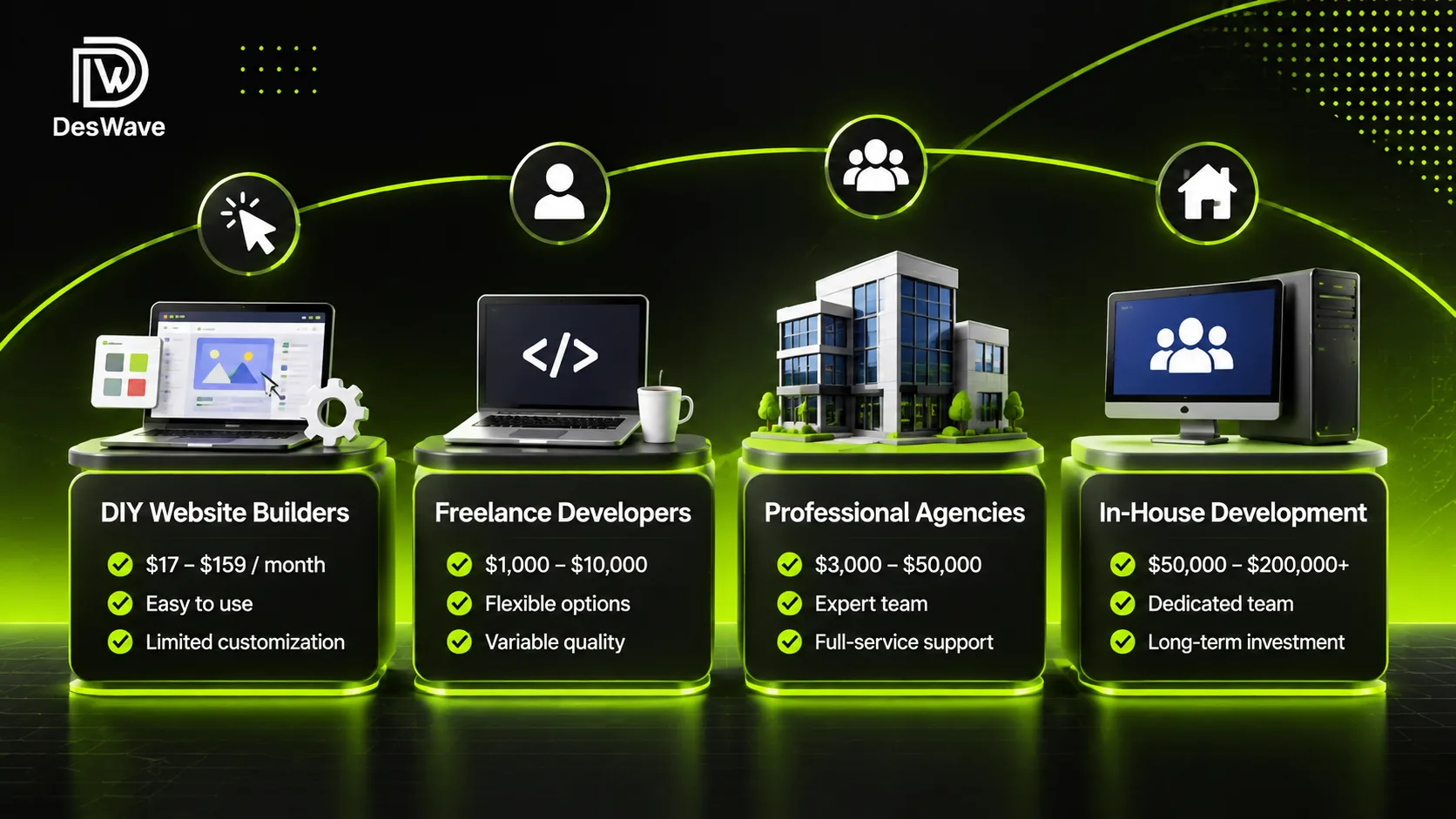
Who builds your site changes the price more than almost anything else. The table compares the four main routes using US 2026 ranges from public sources. Rates vary by city and skill. A cheaper rate can still cost more overall if the work needs fixing later.
|
Approach |
Typical price |
Pricing model |
Best for |
Watch out for |
|
DIY builders |
Wix $17 to $159 per month, Squarespace about $16 to $99, Shopify $29 to $299 (annual billing) |
Subscription |
Personal sites, simple stores |
Limited code access, plan upgrades |
|
Freelance developers |
$85 to $135 per hour (mid level US), $1,500 to $8,000 for a 5 to 10 page site |
Hourly or fixed |
Small business sites |
Availability, single point of failure |
|
Agencies |
$100 to $200 per hour, $5,000 to $25,000 for 5 to 10 pages |
Fixed, hourly, or retainer |
Growing businesses, complex builds |
Higher rates, minimum project size |
|
In house team |
$60,000 to $150,000 per year per developer (US) |
Salary plus benefits |
Products that change weekly |
Hiring time, overhead |
DIY Website Builders
Builders bundle hosting, templates, and security into one subscription. Wix runs $17 to $159 a month, Squarespace roughly $16 to $99, and Shopify $29 to $299, all on annual billing. Squarespace changed its plan prices in July 2026, so confirm current rates before you buy.
You get speed and low risk. You give up code access, deep SEO control, and custom back end logic. Watch renewals too, because first year promos can rise later.
Pick a builder when your site is simple and your time costs less than a developer’s.
Freelance Web Developers
Freelancers charge less because they carry less overhead. A mid level US developer bills about $85 to $135 an hour, per Second Talent’s 2026 data, and a five to ten page site often runs $1,500 to $8,000. Eastern European rates can fall to $25 to $50 an hour. You get direct access and flexible pricing. You also get one point of failure.
If your freelancer gets sick or busy, your project stalls. Ask for a written scope, source code ownership, and a backup plan. Hourly deals make the website development price a moving target, so insist on a cap.
Professional Web Development Agencies
Agencies bring a team, with a project manager, designer, developer, and QA tester. Clutch’s 2025 survey, cited by Digitano, shows US agency rates of $100 to $200 an hour.
Full web development services from a team like Deswave cover discovery, design, code, testing, launch, and support under one contract.
You pay for overhead, but you also get accountability and faster recovery when someone leaves. Agencies fit growing businesses, custom features, and projects with hard deadlines.
Get a Clear Quote from a Team That Itemizes
Request a QuoteIn-House Development Teams
An in house developer works only for you. US full time pay runs about $60,000 to $150,000 a year, per a 2026 hiring guide, before benefits, tools, and management time. That’s the right call for products that change weekly, like a SaaS app.
It’s the wrong call for a ten page marketing site. Hiring also takes months. One developer can’t cover design, security, and server work alone, so many companies pair a small in house team with an agency for big builds.
What Factors Affect Website Development Costs?
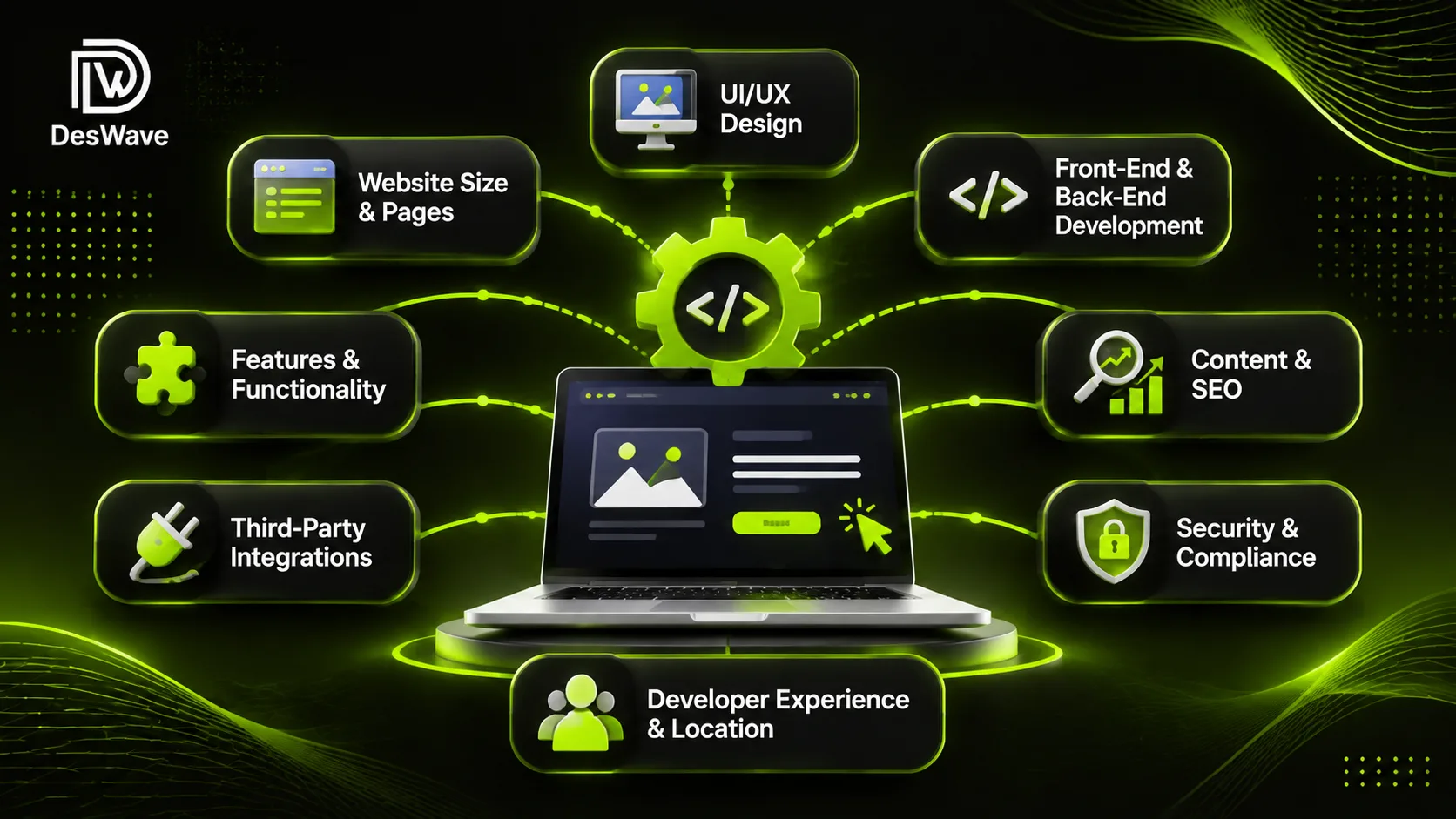
Two websites can both have ten pages and still differ by thousands of dollars. Pages measure size, not work. One site shows text and photos. The other runs a booking engine, a member login, and payments behind the scenes.
Developers price effort, risk, and long term responsibility. These eight factors move your website development price the most, in roughly the order a developer raises them during scoping.
Website Size and Number of Pages
Think of website construction cost like building a house. Square footage matters, but the floor plan matters more. Twenty pages built from three templates cost little. Twenty pages with twenty unique layouts cost far more, because each layout needs design, code, and testing on phones, tablets, and desktops.
Content volume adds work too. Moving 300 old pages into a new system takes real developer hours for redirects, formatting, and image handling.
Count your unique page types, not your total pages. Then tell every bidder the same number so quotes compare fairly.
UI/UX Design and Customization
Design time depends on how much thinking comes before pixels. Research, wireframes, clickable Figma prototypes, and design systems each add hours. Brand strategy services usually come first, because they define your audience, voice, and visual identity.
Skip that step and you risk a pretty site that confuses buyers, then you pay for a redesign. Custom animations, unusual layouts, and detailed interactions raise front end hours too.
A template with smart edits costs less. A custom design costs more but fits your brand better. Decide which one your goals need.
Front-End and Back-End Development
Front end code runs in the browser. It builds what visitors see and touch, using HTML, CSS, and JavaScript, often with React, Vue, or Next.js. Back end code runs on a server. It handles logins, payments, and data, using PHP, Node.js, or Python, plus a database such as MySQL or PostgreSQL. APIs connect the two sides and outside tools.
Your stack changes your bill. A WordPress site runs on PHP and a MySQL database, and it ships fast because themes and plugins do much of the work. A headless setup splits things up. Next.js draws the pages while a separate CMS stores content. That costs more up front, since you build and maintain two systems, but it can load faster and scale better.
Speed carries a price tag too. Google’s Core Web Vitals set targets of 2.5 seconds for Largest Contentful Paint, 200 milliseconds for Interaction to Next Paint, and 0.1 for Cumulative Layout Shift. Hitting them takes image tuning, caching, and clean code. Ask your developer to test against these numbers before launch.
Features and Functionality
Every feature adds design, code, testing, and upkeep. Here’s a hypothetical example. A basic contact form takes a few hours. A booking system with payments, reminders, and calendar sync can take weeks, plus monthly fees for the tools behind it.
User accounts raise the stakes again, since you now store personal data and need password resets, permissions, and security reviews.
Write a must have list and a nice to have list before you request quotes. Developers can then price the first release and leave the rest for phase two. That habit alone often cuts the cost of website development without hurting quality.
Content Creation and SEO
Content costs money even when nobody mentions it. Copywriting, photos, video, and product descriptions add up fast, and thin content hurts rankings. Technical SEO needs build time too. That means clean headings, fast pages, XML sitemaps, redirects, and schema markup.
Search has changed as well. AI tools like Google’s AI Overviews, ChatGPT, Gemini, and Perplexity pull answers from pages that state facts clearly.
No developer can promise you a spot in those answers. Still, answer first writing, descriptive headings, and structured data make your pages easier for machines and people to understand. Plan that work during the build. Retrofitting a finished site costs more.
Third-Party Integrations
Every connection to an outside tool adds work. Payments, CRM systems, email platforms, maps, chat widgets, and accounting software each need setup, testing, and error handling. Many charge usage fees through APIs, such as per map load or per text message.
Those fees stay invisible until traffic grows. Ask each bidder to list every outside service your site needs, who pays for it, and what happens if a provider changes its pricing.
Shopify shows this well, since app costs can add $50 to $200 or more per month, based on one 2026 comparison.
Security and Compliance Requirements
Rules shape your scope, so read this part twice. This isn’t legal advice. Ask a lawyer which laws apply to you.
GDPR covers sites that target or track people in the EU or UK. Violations can bring fines up to €20 million or 4% of global yearly revenue, whichever is higher. Expect costs for a consent banner, a privacy policy, data request tools, and cookie controls. US state privacy laws, like California’s CCPA and CPRA, apply based on revenue or data volume thresholds, so many small sites fall outside them. Some don’t. Check before you assume.
PCI DSS applies when you handle card data. A hosted checkout from Shopify or Stripe shrinks your scope. A custom checkout on your own server grows it, and the security work grows with it. The current version is PCI DSS 4.0.1.
WCAG is the accessibility yardstick that many lawsuits and settlements point to. Aim for WCAG 2.2 Level AA. Building it in costs far less than fixing it later. Also budget for a security scan or penetration test if you store user data. Ask each vendor to price these as separate line items.
Developer Experience and Location
Rates follow skill and location. A mid level US freelance developer bills about $85 to $135 an hour, and a senior agency developer can bill far more. Eastern European freelancers often charge $25 to $50. Cheap rates aren’t always cheap results.
A junior developer may take longer and leave bugs behind. Look for experience with your exact stack and your industry rules. Ask for two similar projects and the tech they used.
Then compare total project cost, not hourly rate. The best bid is the one that finishes right the first time.
Website Development Cost Breakdown
Looking at website construction cost line by line shows where the money really goes. Some items happen once. Others repeat every month or year. The table splits them so you can budget both. Ranges assume a small business site and US prices. Provider pricing changes often, so check current plans before you buy.
|
Cost item |
Type |
Typical range |
What it covers |
|
Domain name |
Annual |
About $11 and up for common domains |
Your web address |
|
Hosting |
Monthly or annual |
A few dollars a month for shared, more for VPS and cloud |
Server space and uptime |
|
Design and development |
One time |
$2,000 to $15,000 for small business sites |
Layout, code, setup |
|
CMS and plugins |
Annual or monthly |
Free core software, premium tools vary |
Content editing, features |
|
SSL certificate |
Annual |
$0 to $200 basic, $1,000 or more advanced |
Encrypted HTTPS connection |
|
Testing and launch |
One time |
Usually bundled in the build |
QA, fixes, go live |
|
Maintenance |
Annual |
$1,100 to $5,000 for many small sites |
Updates, backups, support |
Domain Name Registration
Your domain is your address, and it costs little. Aibrify’s 2026 cost guide puts domains near $11 a year, though premium names can cost far more and renewal prices sometimes beat the first year price. Register the domain under your own account, not your developer’s.
That one move protects you if a project ends badly. Turn on auto renew and domain lock, and add a backup email for recovery.
It’s the smallest slice of website creation cost, yet losing a domain can cost you your whole brand online.
Website Hosting
Hosting is where your site lives, and your choice affects speed, uptime, and bills. Shared hosting puts many sites on one server. It’s cheap, often a few dollars a month, and fine for small brochure sites, but noisy neighbors can slow you down.
VPS hosting gives you a private slice of a server with set resources. Plans commonly run about $20 to $100 a month, and someone has to manage updates. Cloud hosting spreads your site across many machines and bills by usage.
It handles traffic spikes well, so it suits stores and apps, but bills can jump without alerts. Prices vary by provider. Match hosting to your traffic and risk, not to the lowest sticker price.
A slow server can wreck your Core Web Vitals no matter how clean your code is.
Website Design and Development
This is the biggest one time line in any website construction cost. Developers price it by the hour or as a fixed bid. A fair quote splits the work into phases, such as discovery, design, build, content, testing, and launch.
Each phase should show hours or a fixed price. Ask how many revision rounds the price includes, who owns the source files, and what happens when you change your mind mid build. A good estimate of the cost of website development also lists what the team won’t do.
Vague quotes turn into change orders fast.
Content Management System (CMS)
A content management system lets you edit pages without touching code. WordPress core is free, which is why the cost to build a website often starts there.
The extras add up. Premium themes and plugins often charge yearly licenses, so list each one in your budget. Shopify and Webflow bundle the CMS into a subscription.
Headless CMS tools charge by users or usage. A fully custom CMS can cost $20,000 to $75,000 according to WebsiteSetup, and that only makes sense for unusual workflows. Pick the lightest system your team can actually use.
SSL Certificate and Security
SSL puts the padlock in the browser and encrypts data between visitors and your server. Browsers warn people away from sites without it, so it’s not optional. Basic certificates cost $0 to $200 a year, and many hosts include a free one, based on SimPalm’s 2026 numbers.
Advanced options can pass $1,000 for extra validation and warranty. Real security goes further. Budget for a firewall, malware scanning, two factor logins, and regular backups. If you take payments or store user data, plan a security review before launch, not after something breaks.
Website Testing and Launch
Testing protects your launch budget. A solid process checks every page on major browsers and phones, tests forms and checkout flows, scans for broken links, runs accessibility checks, and measures Core Web Vitals. Launch tasks include 301 redirects from old URLs, analytics setup, sitemap submission, and backups.
Skip redirects and you can lose rankings overnight. Ask for a bug fix window after launch, often around 30 days. Any website development price that leaves out testing is incomplete, so request it as its own line item.
How Much Does Website Development Cost by Platform?
Platform choice shifts website development cost more than most owners expect. Each option trades money, control, and speed. The table gives a side by side view. Monthly prices use annual billing from 2026 sources, and Squarespace changed its prices in July 2026.
|
Platform |
Typical cost |
Technical base |
Strength |
Limit |
|
WordPress |
$3,000 to $15,000 for a pro build, developers about $50 to $95 per hour |
PHP, MySQL |
Flexible, huge plugin pool |
Needs updates and security care |
|
Shopify |
$29 to $299 per month, plus apps and fees |
Hosted, Liquid templates |
Fast store setup |
App and transaction fees stack up |
|
Wix |
$17 to $159 per month |
Hosted, drag and drop |
Easy editing |
Limited code access |
|
Squarespace |
About $16 to $99 per month |
Hosted, templates |
Clean design |
Limited customization |
|
Custom coded |
$10,000 to $25,000 basic, higher with features |
React, Next.js, Vue, Node.js, Python |
Full control |
Highest upkeep |
WordPress Website Development Cost
WordPress powers a huge share of the web, and its cost range is wide. A DIY start sits near $95 to $180 in year one, per WebsiteSetup, and the same source lists professional WordPress developers at about $50 to $95 an hour.
Costs rise with custom themes, premium plugins, and WooCommerce. WordPress development requires familiarity with PHP alongside WordPress-specific architecture, including themes, plugins, hooks, security practices, and database management.
Outdated plugins are a common way sites get hacked, so budget for monthly updates.
Shopify Website Development Cost
Shopify suits stores. Plans run $29 to $299 a month on annual billing, according to Website Builder Expert, and card rates start near 2.9% plus 30 cents on the entry plan. Apps fill the gaps, and one 2026 comparison puts typical app spending at $50 to $200 or more a month.
Developers customize themes with Liquid, Shopify’s template language, and build custom apps through APIs. Shopify shortens launch time and shrinks your PCI scope. The price you pay is monthly fees that grow with sales.
Wix Website Development Cost
Wix gives you drag and drop editing and bundled hosting. Paid plans run $17 to $159 a month on annual billing, and you need a plan above the entry tier to sell online. Wix fits small service businesses and portfolios. It also locks you in.
You can’t export your site’s code to another host, so a later move means a rebuild. Wix offers a developer tool called Velo for custom code, but you still work inside Wix’s limits. Check the renewal price, because first term discounts end.
Squarespace Website Development Cost
Squarespace leans toward design and simple content sites. Its plans run about $16 to $99 a month on annual billing, though prices changed in July 2026, so verify before you commit. Templates look polished out of the box, which trims design costs.
Customization stays limited compared with WordPress. Large catalogs and multi channel selling can push you toward Shopify.
Squarespace works well for creators, studios, and small service firms that want a clean site without hiring a developer.
Custom-Coded Website Development Cost
Custom code means your team picks the stack. A common modern setup pairs React or Next.js on the front end with Node.js or Python on the back end and a PostgreSQL database.
Basic custom builds start near $10,000 to $25,000 in one 2026 guide, and costs climb with features and traffic. You get speed tuning, tight security control, and room to grow.
You also pay a developer for every update. Choose custom code when templates block a real business need, not because it sounds impressive.
One-Time Website Development Costs vs. Ongoing Expenses
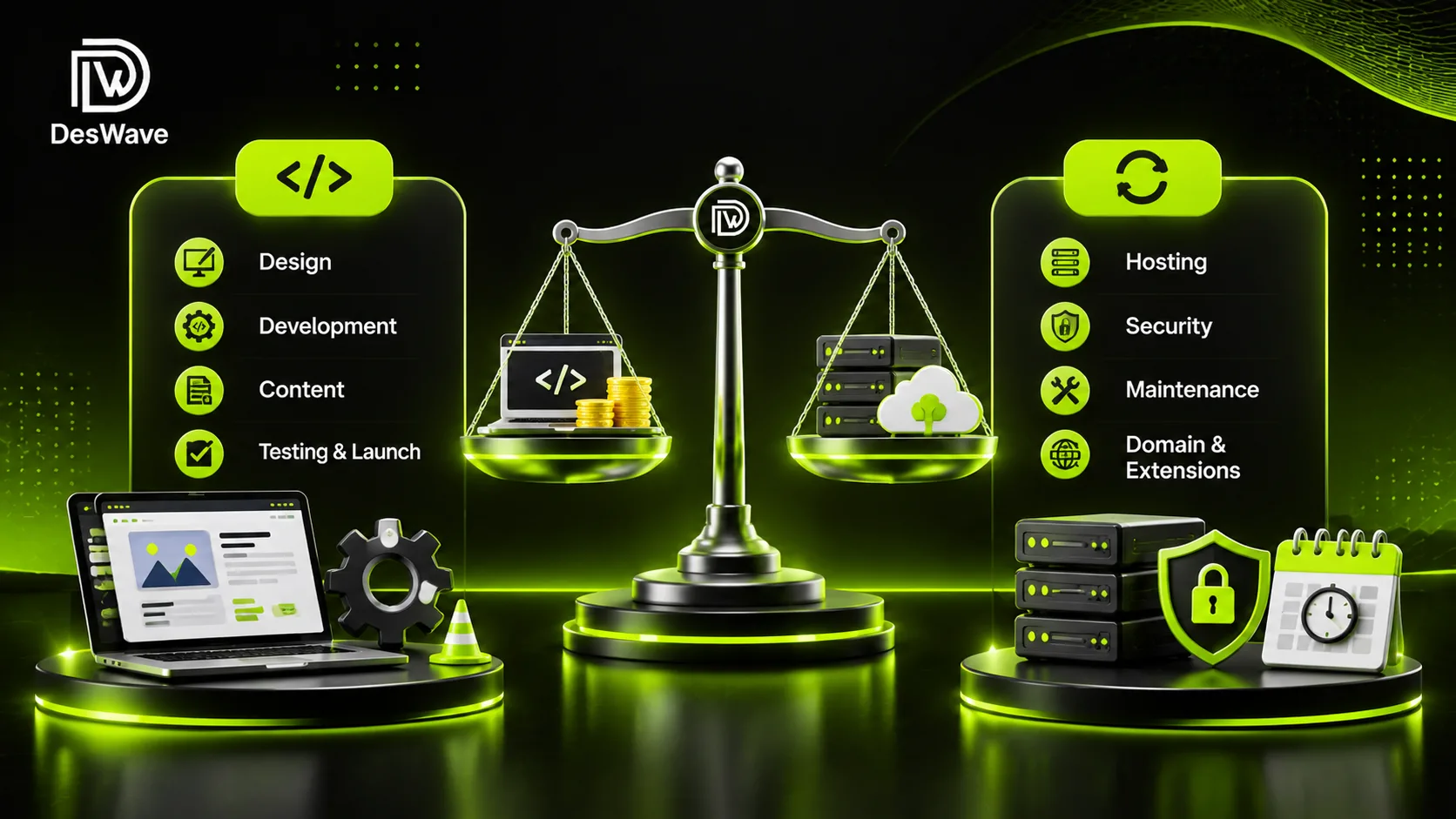
Think of a website like a car. The build is the purchase. Hosting, upkeep, and licenses are fuel and service. Owners who budget only for the purchase get surprised every year after that. The website creation cost on a proposal usually covers year one of the story, nothing more.
One time costs include discovery, design, development, content, testing, and launch. Recurring costs include domain renewals, hosting, premium themes and plugins, security and backups, maintenance, content updates, and tool subscriptions. Renewal prices often beat first year promos, so read the fine print.
To estimate a three year total cost of ownership, add the build cost to three years of running costs, then add a reserve for a refresh. The table shows a hypothetical small business example. It assumes an $8,000 build, shared hosting, a few premium plugins, and a monthly maintenance plan. Your numbers will differ.
|
Line item |
Year 1 |
Year 2 |
Year 3 |
|
Build (one time) |
$8,000 |
$0 |
$0 |
|
Domain |
$15 |
$15 |
$15 |
|
Hosting |
$300 |
$300 |
$300 |
|
Premium plugins and licenses |
$300 |
$300 |
$300 |
|
Maintenance and updates |
$1,200 |
$1,200 |
$1,200 |
|
Security and backups |
$300 |
$300 |
$300 |
|
Content updates |
$600 |
$600 |
$600 |
|
Running costs per year |
$2,715 |
$2,715 |
$2,715 |
|
Cumulative total |
$10,715 |
$13,430 |
$16,145 |
Running costs add up to $8,145 over three years, which is just over half the final bill. That sits inside the $1,100 to $5,000 yearly range reported in a small business website cost study.
So, when you ask how much does it cost to build a website, ask for the three year number too. The website development price on the proposal covers only the first line of that table.
Website Maintenance Costs After Launch
Building code is only half the battle. Owning a digital product means paying recurring fees to keep systems online, secure, and fast.
Expect website maintenance costs to be 15% to 20% of your initial cost of website development each year if your initial build costs $40,000, set aside $6,000 to $8,000 annually for operations.
This budget covers hosting infrastructure, server patches, API license fees, and security monitoring. Ignoring post-launch maintenance leads to broken checkout flows, slow database response times, and dangerous security holes that alienate visitors.
Website Updates and Bug Fixes
Custom software accumulates technical debt. Core browser engines like Chromium update regularly, which can break front-end JavaScript scripts or CSS layouts.
Your developer must spend hours updating front-end dependencies, debugging UI elements, and fixing broken user flows.
Content changes, new landing pages, and micro-feature requests also require developer time. Most small businesses budget $200 to $1,000 monthly for custom code updates and developer support.
Security Monitoring and Backups
Data breaches cost companies real money and reputation. Production servers require automated malware scans, Web Application Firewalls (WAF) like Cloudflare, and automated daily database snapshots stored off-site.
If your site processes customer profiles or payment tokens, security monitoring is mandatory. Set aside $50 to $300 monthly for enterprise SSL certificates, firewall software licenses, and cloud snapshot backups.
Plugin and Software Updates
Modern CMS platforms depend on third-party software packages and open-source plugins. Outdated software libraries create massive security vulnerabilities that hackers exploit.
Updating plugins requires testing changes inside a staging environment before pushing code to your production server.
This prevents server crashes and code conflicts. Expect to spend $50 to $250 per month on premium module subscriptions and developer testing hours.
Technical Support and Performance Monitoring
If your site crashes during a marketing campaign, you lose money every minute. Professional Web Development Services include Service Level Agreements (SLAs) for server uptime, page load speed monitoring, and emergency support.
Server monitoring tools track database query speeds and Core Web Vitals performance metrics continuously. Dedicated technical support plans range from $300 to $2,500 per month depending on response times and team size.
How Long Does It Take to Develop a website?
Project schedules depend on custom features and engineering complexity. A simple marketing site built with existing UI templates takes 3 to 5 weeks.
A custom web application using Next.js, Node.js, and complex PostgreSQL databases takes 4 to 9 months. Development timelines include wireframing, backend logic design, frontend assembly, API integration, and quality assurance testing.
Client feedback loops and late content delivery often push release dates back by weeks.
How to Estimate Your Website Development Budget
To project your true website construction cost, outline your functional needs before asking for agency quotes. Separate mandatory core features from optional additions.
Calculate your baseline cost using four pillars: front-end UI complexity, back-end system architecture, third-party API tools, and custom content needs. Include custom Brand Strategy Services to align design systems with user acquisition goals before writing code.
Always add a 15% contingency reserve to your website development price calculation. Scope creep and unexpected technical requirements during testing can increase overall engineering hours.
How to Reduce Website Development Costs Without Compromising Quality
You can cut project costs without shipping broken software. Start by using pre-built UI components or frameworks like Tailwind CSS instead of custom-coding basic visual design elements from scratch. Focus initial builds on core user value rather than adding complex feature lists right away.
Write your website content, product text, and media assets early so developers do not waste billable engineering hours waiting for copy.
Choose reliable headless CMS tools that allow your internal marketing team to manage landing pages without needing ongoing custom code modifications.
How to Choose the Right Website Development Company
Picking the wrong technical partner destroys project budgets faster than unexpected code bugs. A low initial bid often hides weak technical skills, poor security practices, and sloppy code architecture.
Selecting an experienced technical partner ensures clear communication, reliable software architecture, and accurate cost estimates. However, if you are seeking top web development companies, look no further than Deswave.
Review Its Portfolio and Previous Projects
Examine past web applications built by the developer team. Do not just look at visual screenshots. Click through live sites, test page speed using Google PageSpeed Insights, and review mobile layouts.
Check if their team has successfully built complex systems like your proposed software scope.
Check Client Reviews and Testimonials
Look for verified client reviews on independent technical evaluation platforms like Clutch or GoodFirms.
Reach out directly to past clients and ask about project communication, adherence to project deadlines, budget management, and post-launch bug support.
Compare Pricing and Project Deliverables
Compare itemized quotes from multiple technical agencies. Avoid vague project estimates that list a single flat price without breaking down engineering hours.
Look for clear breakdowns for UI/UX design, front-end code, back-end logic, database construction, and testing phases.
Evaluate Technical Expertise and Support
Verify that the development team understands modern web tech stacks like React, Vue, Node.js, and cloud hosting platforms like AWS or Vercel.
Ask how they handle security compliance, database scaling, search engine optimization, and code documentation.
Understand the Development Contract
Review contract terms carefully before signing. Check who owns the intellectual property rights to the final codebase.
Ensure the contract includes a 30 to 90-day warranty window covering post-launch bug fixes at no extra cost.
Partner with Deswave for Premier Website Development Services
Get a Free ConsultationFinal Thoughts
Ultimately, standard web development cost in 2026 isn’t just about what you spend today, it’s about the ROI your digital presence yields tomorrow. Whether you need a sleek landing page or an enterprise digital platform, your budget should fuel measurable business growth rather than just cover code.
Ready to turn your budget into a high-converting machine? Partnering with the right experts makes all the difference. Explore premier Website Development Services tailored to your goals with Deswave, where performance, cutting-edge technology, and seamless user experience come together to elevate your brand.